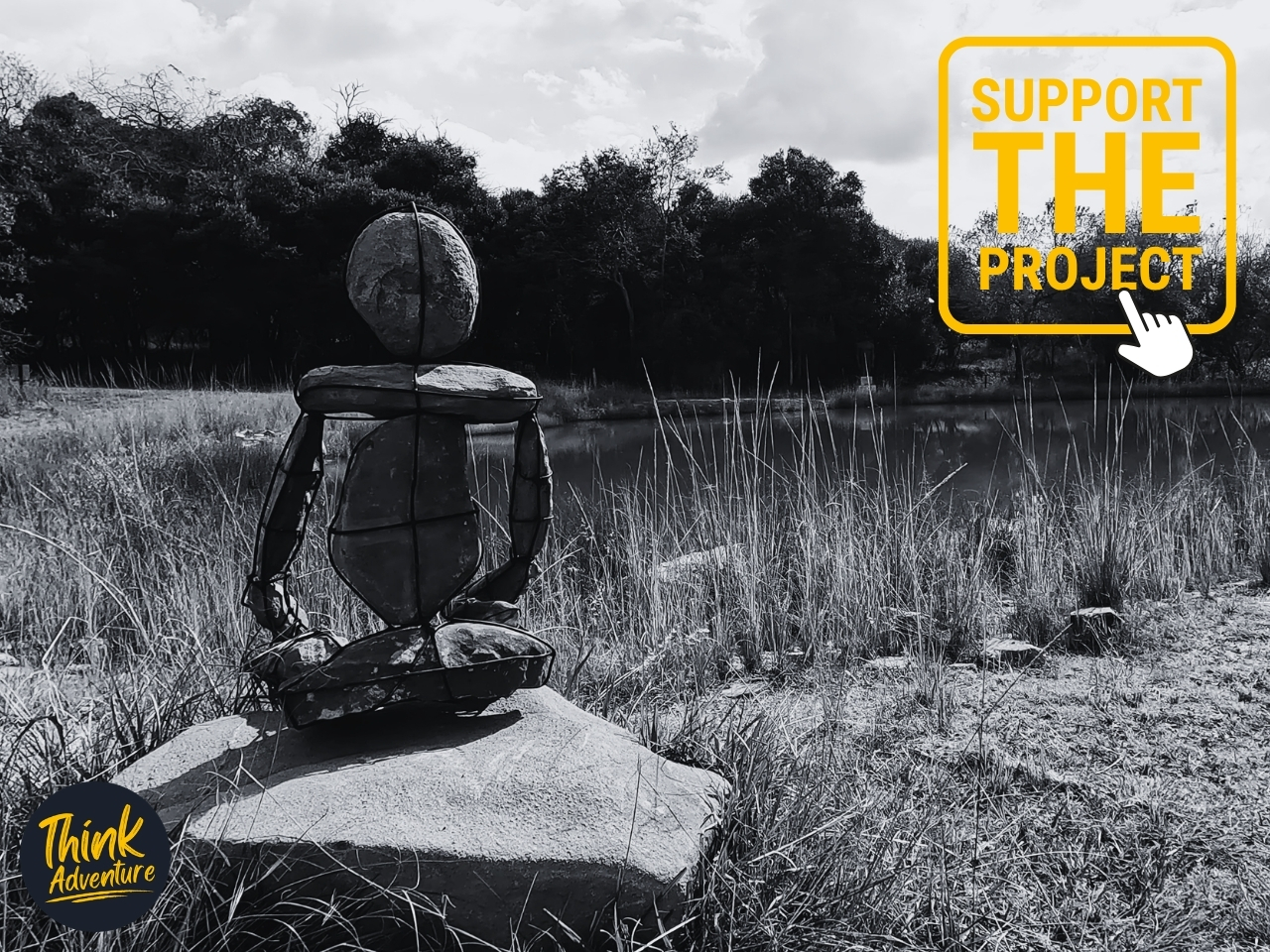
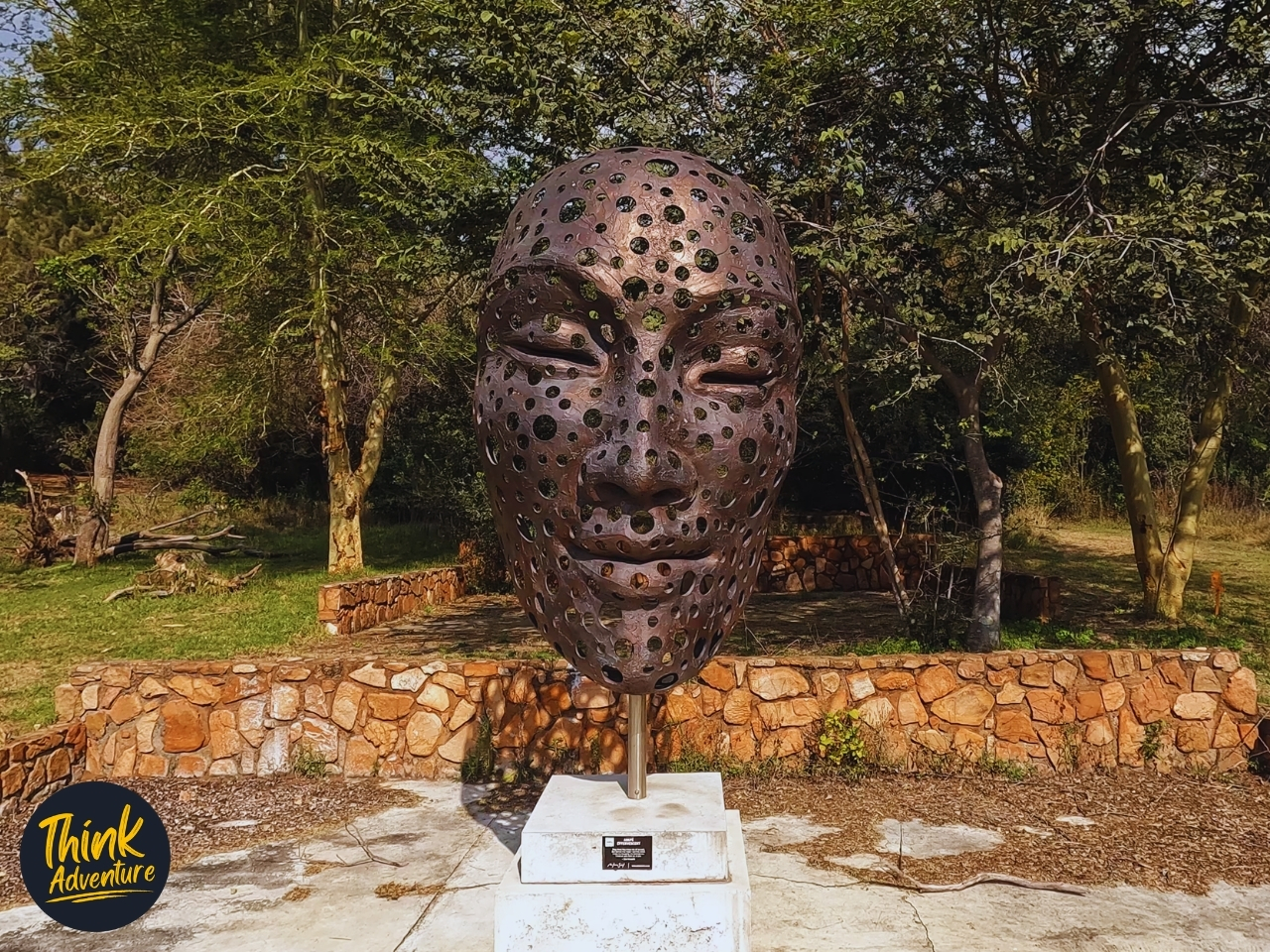
I came for a hike. The first thing I did was speed-walk past a bronze face the size of a car wheel, a wire-and-rock figure watching me from the lawn, and a woman made of blue dots with her arms stretched wide — straight to the nearest toilet.
Two coffees on the drive will do that to you.
To be fair, Milorho Hiking Trails was not what I expected the moment I pulled through the gate. I’d braced for a car park and a trailhead. What I got was an outdoor sculpture park with hiking on the side — or at least, that’s how it felt at first. Perforated metal masks peering out from the reception walls. Cut-steel animals standing in the bush like ghosts of the real thing. A small stone figure, built from wire and rock, sitting on a boulder at the edge of a dam — staring at the water like he had somewhere better to be and had given up caring.
I found the toilet eventually. Then I went back to look properly.
Milorho sits in the Rietfontein area just outside Buffelspoort, tucked against the Magaliesberg — about 110 kilometres from Centurion if you take the scenic route, which you should. The road climbs over Hartbeespoort Dam and threads through the mountain range, and on a cool winter morning with the window cracked and the cold air coming in, it’s the kind of drive that puts you in the right mood before you’ve even laced up.
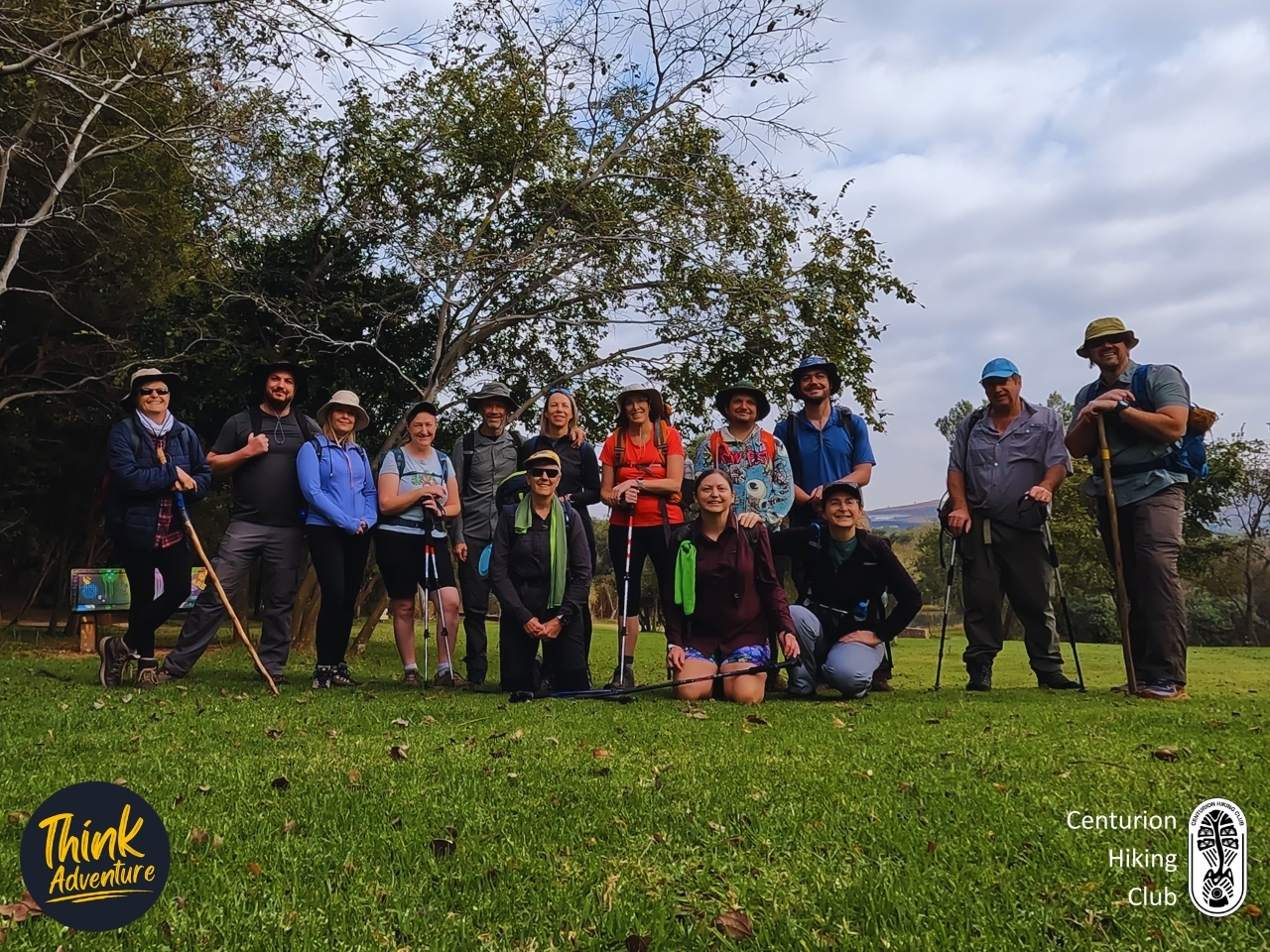
I was the first to arrive. The parking area was empty, the shade was plentiful, and I took full advantage of both. Thirteen more hikers trickled in over the next while — ten familiar faces, three new ones — and by the time we’d geared up, taken the group photo, and been briefed by the staff on how the trail system works, there were fourteen of us ready to disappear into the bush.
We chose the green trail. Twelve kilometres. That sounded very reasonable at the time.
The green trail doesn’t waste time. Within the first few hundred metres it starts climbing — nothing savage, just enough of a gradient to wake the legs up and remind you that you’re not on a stroll. The bush around you is open, the winter light coming through in patches, the path underfoot loose in places where the rock breaks the surface.
And there’s a lot of rock. Boulders the size of small rooms scattered through the landscape like they’d been dropped there and forgotten — some stacked, some split, some leaning against each other at angles that suggest a structural conversation nobody finished. We were maybe twenty minutes in when the trail offered a short detour to the rock pools, and we took it without much debate.
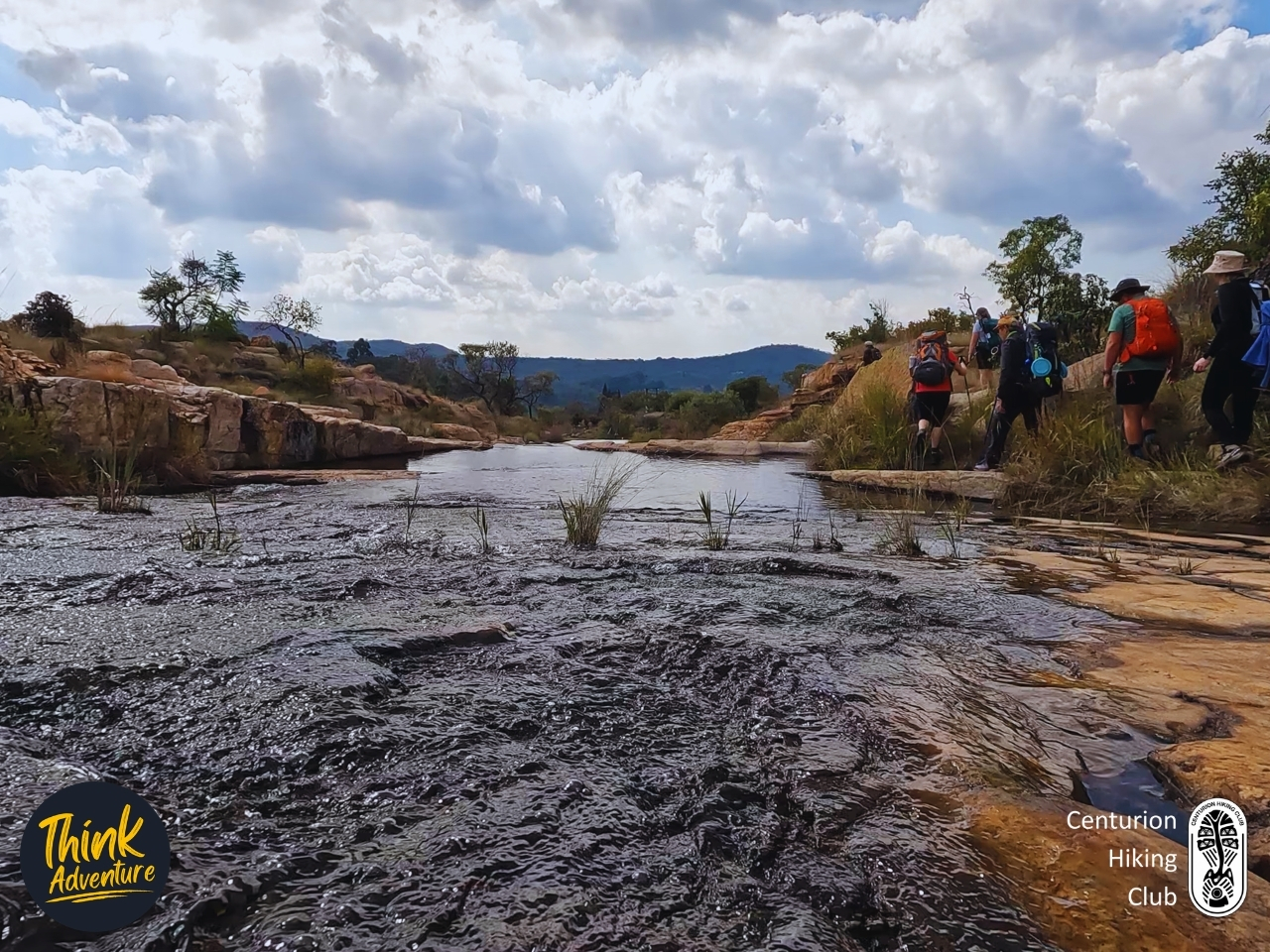
It was worth it. The water was there — you could hear it before you saw it, trickling down through the rock and settling into natural basins carved out over what must be an unreasonable amount of time. Nobody said much. We looked, took it in, and moved on.
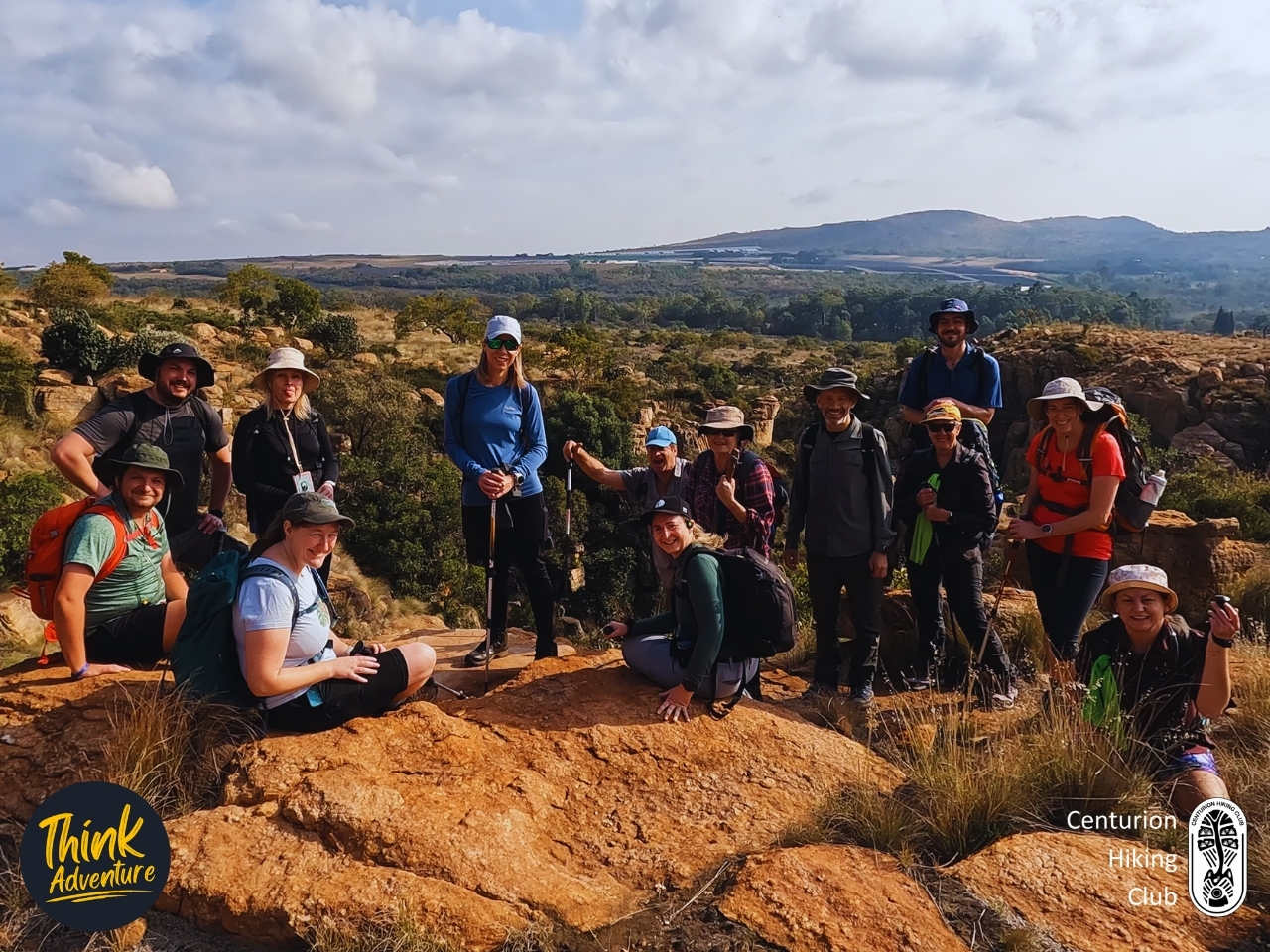
I got most of my group photos during the first half. People are energetic, smiles come easily, and nobody’s legs have turned on them yet. Once the trail gets more challenging, so does the convincing.
The art doesn’t stay behind at reception. Scattered along the trail you come across pieces that stop you mid-stride — a horse built from thick coils of wire, a granite form carved into something deliberate and quiet. They appear without warning, and that’s exactly the right way to find them.
At a certain point the trail presents a choice. Eight kilometres or twelve. The shortcut peels off to the right and gets you back to the car sooner. The full route keeps going. We put it to the group. Fourteen hikers, one vote, zero dissent — twelve kilometres it was. I wasn’t surprised. This is the kind of group that came to hike, not to negotiate with a trail.
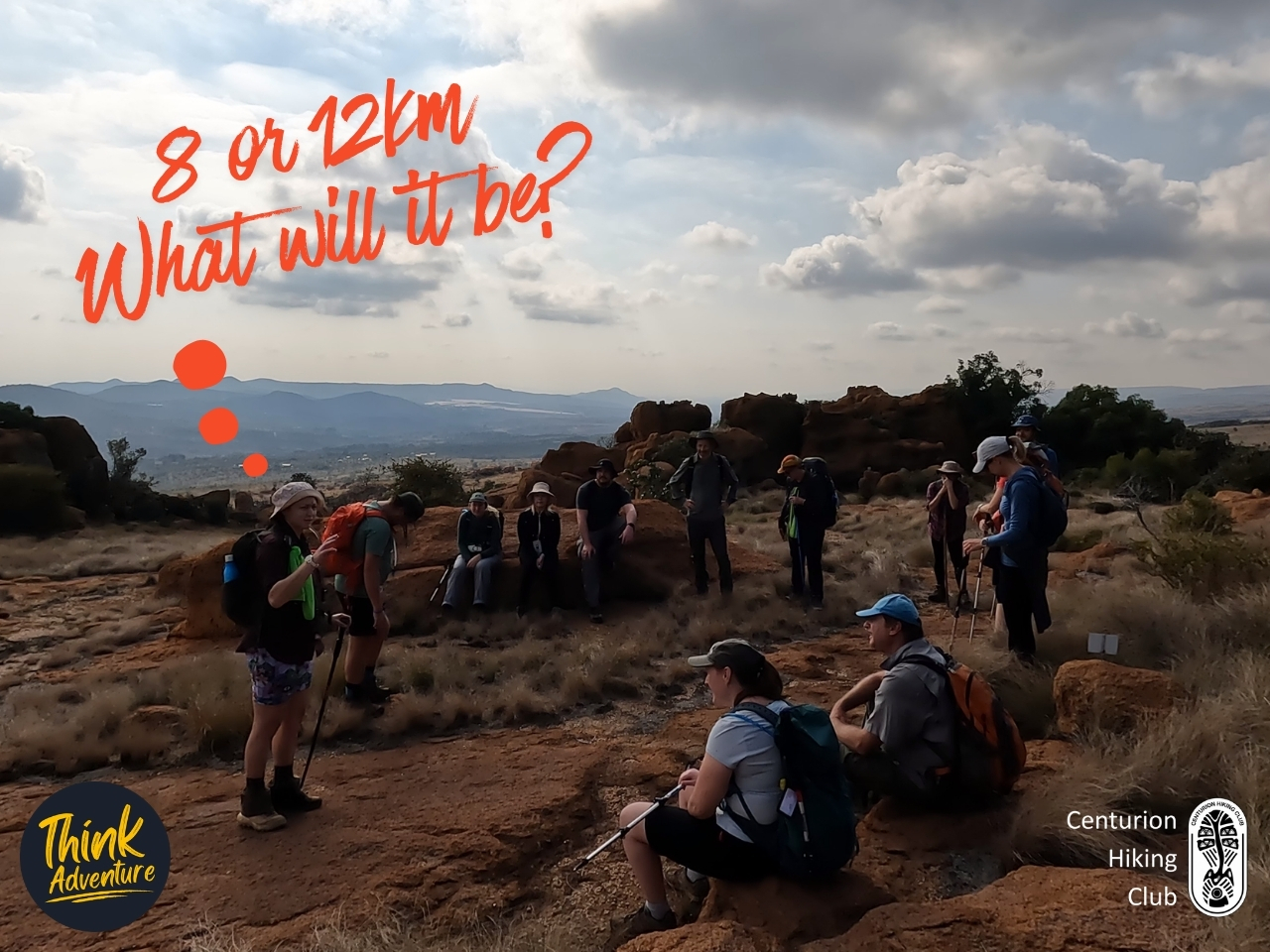
Two thirds in, we earned a break. Found a patch of shade, dropped the packs, and sat with it for thirty minutes — water bottles out, trail snacks doing their job, nobody in any great hurry to stand up again. It’s the kind of pause that doesn’t need conversation to justify it. You sit, you drink, you look at where you’ve come from, and then you get up and finish what you started.
The last third is where the trail earns its keep. It rolls up and down, looping back toward the camp, and in places the path disappears into the overgrowth just enough to make you pause and look twice. The hike leaders worked out the way forward while the rest of the group caught their breath and enjoyed the unscheduled rest. Nobody complained. If anything, it added something — a reminder that you’re navigating, not just following arrows.
Closer to camp the trail passes a second set of rock pools. I stopped long enough to take a few photos and moved on. Through the trees you start to catch glimpses of the glamping tents nestled into the bush — canvas and shade and the quiet promise of somewhere to sit.
The trail ends where the morning began, back in the sculpture park next to reception. Twelve kilometres and 489 metres of elevation gain later, according to Strava. And this time, with no urgent business elsewhere, I actually stopped to look. The blue-dot woman with her arms open. The stone figure by the dam. The perforated face watching from its pedestal. I’d walked straight past all of them that morning without a second glance. Funny what changes after 12km in the bush.
The best moment of the day didn’t have a view. It happened two thirds into the trail, in a patch of shade, with a water bottle and a good conversation.
There’s something about being properly tired — not broken, just worked — that strips away the small talk. Sitting with a fellow hiker while the rest of the group recovered around us, the conversation went somewhere worth going. I don’t think it would have happened in a coffee shop. The trail has a way of loosening people up.
Sitting there, I found myself glad I’d made the drive. A hundred and ten kilometres is a commitment on a winter morning. But Milorho is the kind of place that justifies the distance — a trail with enough variety to keep you honest, set inside a venue that nobody would describe as typical. The art, the glamping tents in the trees, the rock pools, the furniture showroom you walk through to collect your hiking permit. It doesn’t fit neatly into a category, and that’s exactly what makes it worth the trip.
The green trail at Milorho is not a casual Sunday stroll. Twelve kilometres with 489 metres of elevation gain asks something of you — not a mountaineer’s fitness, but a decent base. The climbing is gradual rather than brutal, no forty-five degree faces, just a persistent upward conversation with the terrain that accumulates over the day. If you’re a regular hiker, you’ll be comfortable. If you’re not, the distance alone will find you out before the elevation does.
The trail is well marked for the most part. There is one section where the path disappears into overgrowth — we backtracked a few metres, found the route, and moved on. Pay attention and it’s not an issue. Don’t, and you’ll add unnecessary distance to an already honest day out.
I can’t think of another hiking venue in the Magaliesberg Biosphere that has a sculpture park at reception and original artwork along the trail. That’s not a small thing. Let it surprise you — it’s better that way.
After the hike, some of the group settled on the patio with a cold drink, others went straight for an ice cream. Both were the right call.
Would I go back? Yes — and I’d do it differently. The glamping tents nestled in the trees are worth a night, and if you’re going to stay over, the eight kilometre trail makes more sense than the twelve. It’s better suited to non-regular hikers, the rock pools near camp are within easy reach, and there’s something appealing about finishing a hike and ending up in water. If you want the best effort-to-reward ratio Milorho offers, that’s probably it.
Hugs and goodbyes in the parking area, a few words to motivate the group toward the next one, and then I was back on the road. Cool drink in the passenger seat cooler, window down, an hour and a half between me and Centurion.
The drive back through Hartbeespoort demands attention — there’s an offramp you need to catch for the shorter route home, and the traffic on a return leg has a way of testing your patience. I managed both.
Somewhere along the way, a cramp worked its way up my right leg. The same leg that had been quietly complaining since the break on the trail. Not enough electrolytes — a lesson I apparently needed to relearn. It was uncomfortable enough to notice and manageable enough to ignore.
I didn’t mind. A bit of discomfort on the drive home usually means the day was worth it.
Milorho Hiking Trails — Green Trail Practical Guide
The Basics
- Location: Rietfontein area, Buffelspoort, Magaliesberg Biosphere
- Trail: Green Trail
- Distance: 12.07km (an 8km shortcut option is available on the trail)
- Elevation gain: 489m
- Duration: Approximately 3 hours 15 minutes to 3 hours 30 minutes moving time
- Difficulty: Moderate — suited to regular hikers with a decent base fitness
- Start time: Gates open early — our group started at 08:30
- Best time of year: Year round. The rock pools are more rewarding in summer when water levels are higher
- Permit cost: R120 per person (correct at time of writing)
- Booking: Advance booking required — you cannot just pitch up. Contact the venue prior to your visit to arrange your permit
- Strava recording: Milorho Hiking Trails
Getting There
Milorho Lodge and Africamps on Google Maps
Parking is free and available on site.
If you’re coming from Centurion or Pretoria, the N4 via Rustenburg is the obvious route — but there’s a shorter option worth knowing about, especially with fuel costs what they are.
Take the N14 toward Krugersdorp and exit at the R512, turning right over the highway toward Lanseria Airport. Continue past the airport and the Lion & Safari Park until you reach a T-junction. Turn left toward Broederstroom and follow the road as it curves right, then left past Pecanwood Estate. Continue straight until you reach the Wimpy at Arrows Rest — also on the R512 — and turn right.
This road takes you over Hartbeespoort Dam and through the Magaliesberg. You’ll see the R104 offramp toward Mooinooi and Buffelspoort — ignore it. Stay on the R512 as it curves left and eventually joins the N4.
Continue on the N4 until the Marikana Road offramp. Turn left onto Marikana Road and drive down to the T-junction. Turn right and drive past ATKV Buffelspoort, then turn left onto Buffelspoort Road. Drive straight past Buffelspoort Dam until you see the Magalies Canopy Tours sign — turn left here.
The tar road becomes a dirt road. Follow it past Sparkling Resort and Magalies Canopy Tours on your left, then Kranskloof Hiking Trails on your right. Milorho Lodge and AfriCamps will appear on your left.
What to Bring
- Water — minimum 2 litres per person
- Electrolyte drinks or sachets (the elevation adds up)
- Trail snacks
- Sunscreen
- Hat
- Trail shoes or hiking boots
- Rain jacket (check the forecast)
- Personal first aid kit
- Chronic medication if applicable
Safety & Logistics
- Cell signal: Good — signal was maintained throughout the trail
- Water on trail: Rock pools are present along the trail. Rather bring all the water you need from the start — a minimum of 2 litres per person
- Wildlife: Some wildlife visible in the distance. Not a concern if you stay on the trail
- Snakes: Possible in this environment. Stick to the path
- Emergency contact: The venue manager’s contact details are displayed at the entrance gate. If hiking without a lead, carry a basic first aid kit and make sure someone knows your plans
Good to Know
- Milorho is more than a hiking trail. The reception area doubles as a furniture showroom and gallery, with original artwork inside and sculptures scattered across the grounds and along the trail. It’s unexpected — and worth arriving with time to take it in before and after the hike
- Cold drinks and ice cream are available at reception after the hike
- Glamping tents are available on site for overnight stays. Combined with the 8km trail and a swim in the rock pools near camp, it makes for a solid weekend outing
- The venue takes security seriously — two gates to pass through on arrival.
Frequently Asked Questions – Milorho Hiking Trails
Where is Milorho Hiking Trails located?
Milorho Hiking Trails is located on the northern slopes of the Magaliesberg mountains near Rustenburg in the North West province. It sits within a pristine 600-hectare nature reserve, situated approximately a 1.5-hour drive from both Pretoria and Johannesburg, making it a highly accessible destination for a day trip or weekend getaway.
Is Milorho Hiking Trails suitable for beginners?
Yes, Milorho Hiking Trails is suitable for beginners if you choose the 4.7km Brown Trail. This well-marked route is easy, family-friendly, and takes about two to three hours to complete as it winds past scenic rock pools and streams. However, the longer 12.4km Green Trail features steep gorge climbs and is better suited for experienced hikers.
How much does it cost to hike at Milorho?
Day hikes at Milorho cost R120 per adult and R100 per child under the age of ten, plus a one-time administrative booking fee of R55 per reservation. If you want to include mountain biking, the day visitor rate for cycling the trails is R150 per person, while overnight guests can access the bike trails for free.
Are dogs allowed on the Milorho Hiking Trails?
No, Milorho Hiking Trails is strictly a pet-free eco-reserve. Pets are not permitted anywhere on the trails, in the campsite, or inside the self-catering cottages due to the presence of free-roaming wildlife and the preservation of the endemic flora. Ground rules are tightly enforced under their right of admission policy to protect the local ecosystem.
Do I need to book in advance for Milorho Hiking Trails?
Yes, you must secure a booking in advance before arriving at the reserve. Milorho limits daily foot traffic to maintain its tranquil environment and strict security standards. Because cell phone reception is limited at the main entrance, completing your booking and receiving the seasonal gate access code beforehand is essential for a smooth arrival.