Star Gazing at Kloofendal Nature Reserve: What to Expect at This Roodepoort Stargazing Event
My hands won’t stop shaking. Not the polite kind of cold-shiver — the kind that comes from somewhere under the skin, somewhere you can’t quite reach with a pair of gloves. I’m standing in a queue in the dark, waiting my turn at a telescope, and I can’t tell anymore if it’s the winter air doing this to me, or something else entirely.
4pm for a 5pm start. Still enough daylight to find your way.
Sign-in happened at the reserve gate first, then I drove up to the parking lot. Right next to the parking was the entrance to the amphitheatre, and that’s where people checked us off before we were allowed onto the amphitheatre grounds.
Kloofendal wasn’t short of company. The Centurion Hiking Club had come out in support, but we were a small piece of a much bigger crowd — the event was sold out, and the turnout was good. Friends of Kloofendal had put the evening together in partnership with the West Rand Astronomy Club.
I found a few familiar faces from the club early and we did what hikers do best — worked it out for ourselves. Rather than wait around, we made our way to where the amateur astronomers were setting up their telescopes, in the amphitheatre area of the reserve. Made sense. If you’re going to spend an evening in the cold, you may as well be standing next to the people with the equipment and the reason you’re there in the first place.
The evening started at the “Sun” — a jungle gym frame built to resemble our star, and the gathering point for the Planet Walk.
From the Sun we moved on, rock to rock, each one holding a small scale model of the next planet out, working our way further and further as we circled the amphitheatre. At each stop the guide paused to drop a bit of knowledge on the group — the sort of thing you nod along to and mostly forget, except for the one that stuck: light from the Sun takes about 8 minutes to reach us, covering roughly 150 million kilometres to do it. Interesting!
By the time we were closing in on the outer planets, still turning that number over in my head, the light around us had thinned properly. That’s where I nearly walked face-first into a low branch — would’ve messed up my perm. Dodged it just in time, though I couldn’t tell you if it was good reflexes or something else. I didn’t think much of it then.
From there it was a short walk to the Ecological Centre, where the presentation was about to start. Or so we thought.
The presenter was an hour late. Not ideal, standing around in a hall that was rapidly filling past capacity. He apologised for it once he arrived, which took some of the sting out. And the wait paid off — he turned out to be a lecturer from the University of Johannesburg, and the talk itself was insightful and one of the highlights of the evening for me.
The hall wasn’t built for the crowd that showed up. Once the talk started, people spilled to the sides and stood for the whole thing, packed in next to stuffed animals — an owl, dung beetles, butterflies, to name a few, along with a handful of other insects I couldn’t tell you the names of if you asked — each with its own glass box and little placard. Off to one side was a section on the reserve’s gold-mining history, for anyone whose attention wandered.
When we first walked in, there was still light outside and the cold hadn’t caught up with us yet. 30 minutes into waiting for the late presenter, we gave up and stepped out for coffee — and that’s when it hit. Dark now, and properly cold, in a way it hadn’t been half an hour earlier.
The presentation itself, once it finally got going, was a condensed astronomy 101, but one fact has stuck with me since: back in 1995, astronomers pointed the Hubble Space Telescope at a patch of sky that looked completely empty, and held it there for 10 days straight in what became known as the Hubble Deep Field. What came back wasn’t nothing — it was roughly 3000 galaxies, hiding in what looked like a gap in the dark. It’s the kind of fact that makes you feel small in the best and worst way at the same time. Like being a single grain of sand on an entire beach.
There was no formal Q&A afterward, though a few people hung back to ask the lecturer questions directly. All told, the whole thing ran close to an hour, though by that point I wasn’t tracking time all that closely.
Stepping out of the hall, the cold met us properly for the first time. I could feel it in my bones — or maybe that’s exaggerating a bit, and it was less the cold itself than something already off in me that made it feel that way. The shaking started not long afterwards. I had gloves, at least, which helped some. It was going to be a long, cold walk from scope to scope.
There were around 7 telescopes set up across the amphitheatre, two smaller ones and the rest proper, sizeable rigs pointed at various angles into the dark. Queues ran 5 to 10 people deep per scope, moving quicker than you’d expect — you took your look, said your thanks, and moved on to let the next person in. The only real hold-up came when someone bumped a scope mid-queue and knocked whatever we were meant to be looking at clean out of frame. The amateur astronomer manning it would recalibrate it, and then it was back to business.
Somewhere between scopes, shivering in the queue, I started thinking what could cause this. Surely it can’t be the temperature only. Rewinding back to the beginning of the day. It’s 6 a.m., still dark, mid-winter cold — the kind of cold you tell yourself you’re fine with once you get moving. I’d gone for a run, feeling like Superman about it, and it had gone fine. Legs worked, lungs worked. The only let down was Strava. Strava failed me towards the end — I was 75% into the run when it just stopped tracking. Why? Escapes me.
It was the power nap that afternoon that should have told me something. Lying on the couch, I felt it — something not quite right, a heaviness that a nap doesn’t normally leave behind. I didn’t make much of it. Figured I’d shake it off by evening.
Standing there now, gloved hands still shaking, cold or otherwise, it started to add up. The nap that hadn’t fixed anything. The tree branch earlier in the walk. And now this — a shake that felt like more than just the temperature. I pushed on anyway, working through what energy I had left, telescope to telescope, doing my best not to let on.
It wasn’t until Sunday morning, waking up with a fever confirmed, that the whole evening made sense in reverse. Every sign had been there. I’d just been too busy looking at the moon to notice.
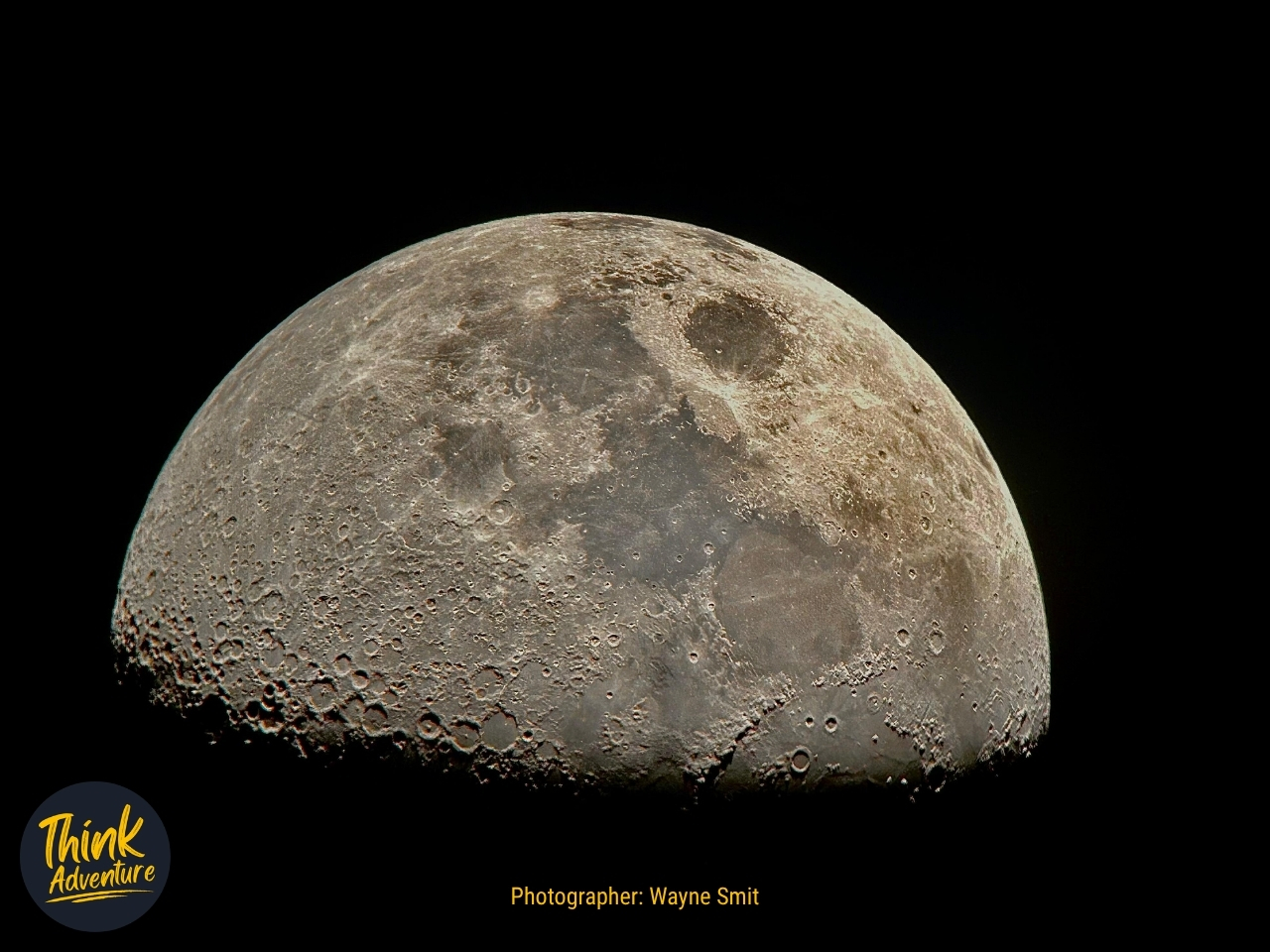
Most of the telescopes are pointed at the moon tonight, some closer in than others. When it’s my turn and I finally get my eye to the lens, this is a first for me — I’ve never looked at the moon like this before. And there it is, up close: not the smooth, still pale circle you get from the ground, but something scarred. Most of it pitted with craters, evidence of a beating that’s been going on for billions of years. Standing there in the cold, surrounded by fellow hikers doing the same thing, it strikes me that maybe that’s the moon’s real job. Taking hits meant for us.
A week before the event, out on a club hike, the conversation had turned to what was coming up. Only half-joking, I laid out my wish list for the night: 1 x Milky Way, 2 x shooting stars, 1 x Northern Lights in the backdrop, and — if we were really lucky — 1 x E.T. doing a flyby in his spaceship, throwing us a peace sign on the way past. A fellow hiker, who’d been part of an astronomy club back in high school, wasted no time bringing me back down to earth. The gist of it: picture 1 telescope, in the middle of a field, pointed at the sky, and people taking turns to look through it. That’s it. That’s the whole thing.
She wasn’t wrong, and she wasn’t exaggerating either — except that “1 telescope” turned into 7, and “a field” turned into an amphitheatre full of people doing exactly that.
No Milky Way. No shooting stars. Definitely no E.T. What we got instead was the moon, up close and scarred, and a lot of very cold people taking turns to see it. Fair trade, in the end.
I’ll be honest — coming down with something I didn’t yet know I had meant I wasn’t as social as I’d have liked to be. I still made my way scope to scope, still asked the odd question, but without the energy I’d normally bring to something like this. On a better night, I’d have lingered longer, asked more, maybe struck up a proper conversation with one of the amateur astronomers about their setup. As it was, I got through it rather than fully into it.
And I’ll be honest about the other thing too: as fascinating as the moon was, it didn’t blow my hair back enough to make me want to go out and buy a telescope of my own. What did stick with me, though, was the passion of the amateur astronomers running the scopes — people who show up, night after night, purely because they love looking up. That’s worth admiring, even if it’s not (yet) contagious for me. Different strokes for different folks.
Would I go back? Yes, without much hesitation — though next time I’d layer up properly. This is an event for the curious rather than the committed stargazer. You don’t need to know anything about astronomy going in. What you do need is warm clothing, patience for how the evening unfolds, and reasonable expectations. If you’re expecting a light show, you’ll be disappointed. If you’re expecting an evening spent looking at something you’ve genuinely never looked at closely outside of a screen before, this delivers.
We got back to the cars sometime after 8, later than planned, colder than I’d planned for. I got the car going to warm it up, said my goodbyes to the fellow hikers, and hit the road.
It took a while. Longer than it should have, probably. But somewhere on the drive home, jacket still zipped to the chin, the shaking finally settled. Whatever had been building in me all evening — the cold, the fever, both — eased off just enough to let the night catch up with me properly. The moon, up close. The craters. A telescope queue in the dark, filled with people who’d paid to stand in the cold and look up.
The shaking stopped. The night stayed with me anyway.
The Practical Guide – Star Gazing at Kloofendal
The Basics
- Activity: Star Gazing at Kloofendal — an evening astronomy event combining a Planet Walk, an astronomy presentation, and public telescope viewing
- Location: Kloofendal Nature Reserve, Roodepoort, Gauteng
- Duration: Roughly 3 hours (17:00–20:00)
- Difficulty: Easy — flat walking on established paths, suitable for all ages and fitness levels
- Best time: Seasonal events, typically run in winter for clearer, earlier-darkening skies
- Friends of Kloofendal on the Web
- Friends of Kloofendal on Facebook
Getting There
- Entrance is off Galena Avenue, Kloofendal, Roodepoort
- Kloofendal Nature Reserve on Google Maps
- Gates and sign-in open around 16:30–16:45; arrive early, as parking and sign-in can take time on a sold-out night
- Security guards are on duty at the gate
- Parking is right next to the amphitheatre entrance, where you’ll sign in before heading onto the grounds
What to Expect
- The evening opens with a Planet Walk, starting at the “Sun” jungle gym, looping through scale models of the planets around the amphitheatre
- This is followed by an astronomy presentation at the Ecological Centre — expect this to possibly run behind schedule, and expect the hall to fill up fast; you may end up standing
- After the presentation, telescopes are set up around the amphitheatre, manned by members of the West Rand Astronomy Club, for public viewing
- No astronomy knowledge or equipment required — amateur astronomers guide you through what you’re looking at
What to Bring
- Warm layers — proper ones. It gets seriously cold once the sun goes down, even more so waiting in queues
- Gloves
- A torch or cell phone light — you’ll be given red cellophane and an elastic band at registration to cover it and protect night vision
- Reasonably priced food and snacks available on-site
Good to Know
- The event sells out — book as early as possible via Quicket
- Tickets were R100 per person at time of writing
- No formal Q&A at the presentation, though the presenter typically stays back for questions afterward
- The reserve is home to Johannesburg’s first gold mine (Confidence Reef Mine, 1884), visible on daytime visits by appointment
- Kloofendal also has its own hiking trails, worth combining with a return daytime visit
Cost and Booking
- R100 per ticket, correct at time of writing (July 2026)
- Booked via Quicket
- Organised by Friends of Kloofendal in partnership with the West Rand Astronomy Club
- Food and drinks sold by Live It Culembeeck Church in support of their fundraising
Frequently Asked Questions – Star Gazing at Kloofendal
Is Star Gazing at Kloofendal Nature Reserve suitable for beginners and families?
Yes, Star Gazing at Kloofendal Nature Reserve is specifically designed to be accessible for families and beginners of all ages. Members of the West Rand Astronomy Club set up high-powered telescopes in the amphitheatre and guide visitors through finding planets, constellations, and deep-sky objects without needing prior knowledge.
Do I need to book tickets in advance for Star Gazing at Kloofendal Nature Reserve?
Yes, you must book tickets online in advance through Quicket because attendance is strictly capped at 250 participants to manage telescope line-ups. Tickets cost roughly R100 for adults, R80 for pensioners, and R50 for children under 12, with proceeds supporting local conservation and astronomy education.
What happens if it is cloudy or rains during Star Gazing at Kloofendal Nature Reserve?
The event goes ahead regardless of cloudy weather or loadshedding. If cloud cover prevents direct telescope observation outside, attendees still participate in the guided scale-model Planet Walk through the reserve and enjoy an interactive astronomy presentation given by club experts inside the Kloofendal Eco Centre.
What should I bring to Star Gazing at Kloofendal Nature Reserve?
You should bring warm, layered clothing, a reliable torch, and your printed or digital entry ticket. Because the reserve sits in a cold valley, temperatures drop significantly after sunset. Upon entry, organizers provide red cellophane to cover torches and cellphones to preserve everyone’s natural night vision.
What time does Star Gazing at Kloofendal Nature Reserve start and end?
The event typically runs from 17:00 to 20:00, with gate access opening at 16:45. It begins with the interactive outdoor Planet Walk at 17:00, moves to an educational presentation in the Eco Centre at 18:00, and concludes with open telescope viewing in the amphitheatre until 20:00.