
Hiking the Groenkloof Nature Reserve Yellow Trail — a 10.5km loop in Pretoria
The trail is barely wide enough for one person, and two ostriches are standing in the middle of it. Neither looks in any hurry to move. I’m most of the way through a hike I’ve done a dozen times, and for the first time all morning I have no idea what happens next.
Groenkloof is 10km from my front door, a 15-minute drive, and it sits right next to Klapperkop — close enough that I’d hiked the one reserve the previous Sunday and was now back at its neighbour. This time it was a Tuesday: 16 June, Youth Day, a public holiday, and a good enough excuse to catch up with a friend I hadn’t seen in a while. We’d planned it a week out. The mood going in was easy. I wasn’t nervous about the trail — I’ve hiked Groenkloof many times over the years and know it well — so the hike was really just the backdrop for the catching up.
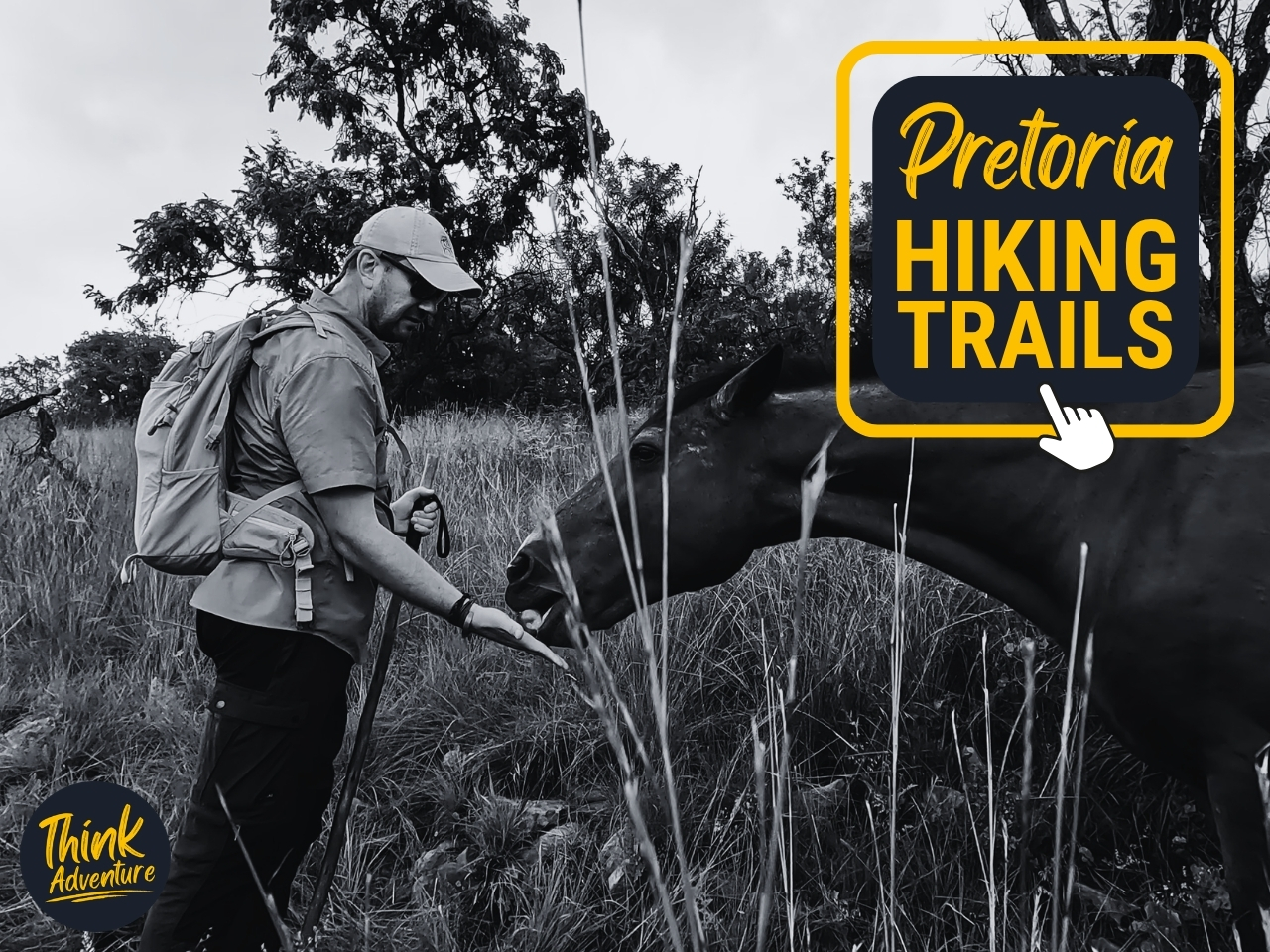
It was a cold, clear winter morning, the kind Pretoria does well in June, and a good deal kinder than the Sunday I’d spent next door at Klapperkop. When you know a place this well, there isn’t much left to surprise you, but the parking area still gets me every time. It’s tucked in under these big old trees — eucalyptus, I think, but don’t quote me — properly big, the kind you stand next to and feel small. Seeing them again after a long gap is half the reason I enjoy arriving. The reserve runs horse rides too, and the horses are usually around somewhere near the start. Nice to see how they’re doing.
The Yellow Trail doesn’t ease you in. It opens with a climb — rock steps cut into the slope, gravel and loose stone underfoot, the gradient steep enough that you pick your pace early or pay for it. We took it slow. The trick was keeping enough breath in the tank to actually hold a conversation, which is harder than it sounds going uphill. The Strava splits backed it up afterwards: that first kilometre was my slowest of the day by a clear margin.

The start and the finish share the same stretch of trail, so there’s tree cover at both ends — shade on the way out, shade on the way back. Birds somewhere in the branches. The air had that dry winter edge to it, and at 7am it was cold enough that you were grateful for the climb warming you up. The light was still flat and blue, the sun not properly over the ridge yet.
Once you’re up, it levels into a contour path and the whole character of the walk changes. The middle of the loop is open field — pale winter grass, the yellow kind, a thin dirt line cut straight through it. No shade out there, but no real effort either. Just easy walking. This is where the conversation did most of its work.
Which was the point of the day, when it comes down to it. We hadn’t seen each other in a while, so we did the rounds — how’s work, how’s home, how’s the kid, how are your folks. Nothing you’d write down. The ordinary catching-up that is somehow the entire reason you drive out and walk 10km on a public holiday. The trail just gave us somewhere to put our feet while we did it.
About 6km in there’s a proper rest spot among the trees — a dustbin, a few rocks to sit on, the kind of place that’s clearly been a rest spot for years. We stopped. Trail snacks, something to drink, 20 minutes of sitting and talking and being in no hurry at all. A few hikers passed while we sat. We greeted them, they greeted back. The usual trail courtesy. Then we got up and carried on.
So. The ostriches.
We’d come around into the last kilometre of the trail when we found them — not beside the path, in it. The trail was narrow here, the kind of single-file width where there’s no real “around,” and two full-grown ostriches were taking up all of it. We’d seen a giraffe on my last visit and I’d half-hoped for a repeat — this was not that. This was bigger, closer, and considerably more capable of ruining the afternoon.
Here’s the thing about ostriches. They’re enormous, they’re faster than you, and if one decides it doesn’t like you, you are not winning that exchange. I was not particularly up for wrestling two grown ostriches on a public holiday. So there was no charging through, no shooing, no clever plan. We just stopped, gave them their space, and approached slowly enough to make it clear we weren’t a problem — hoping, mostly, that they’d come to the same conclusion and find another way.
They did. In their own time, with no urgency whatsoever, they ambled off the path and let us through. I got a short video of them as they went, two birds wandering off into the dry grass like they’d had somewhere to be all along and we’d just been in the way. Crisis, such as it was, averted. We carried on.
Should you actually do this one?
Depends who you are. If you’re a new hiker, I wouldn’t start here. The 10.5km Yellow Trail is a fair distance with a genuine climb at the front, and it’s a lot to take on if you’re still finding your feet. The reserve has two shorter options — the Red (3.5km) and the White (3.7km) — and that’s where I’d send a beginner first. Same reserve, somewhat the same views, far gentler introduction.
If you’re reasonably fit, though, you’ll be fine. The only part worth warning you about is that opening climb. It’s rock steps and loose gravel and it doesn’t let up for a while, and if you’re trying to hold a conversation on the way up — which we were — you learn quickly that slow is smooth and smooth is fast. Pace it. Don’t race it. Once you’re over the top it settles into easy walking and the hard part’s behind you.
One thing to plan around: the middle of the loop is open field with no shade at all. On a cold June morning that’s a non-issue — pleasant, even. In summer it would cook. If you’re doing this in the warmer months, go early and take more water than you think you need.
And keep your wildlife expectations honest. You might see something, you might not — we got ostriches this time, a giraffe the last. But don’t arrive expecting to walk among the herds like it’s the Serengeti and the wildebeest are migrating. That’s not what this is. Anything you do see is a bonus, not the point.
So what’s the point? For me it’s simple. It’s 15 minutes from my door, it’s a proper dose of nature and exercise, and on this particular day it was a place to catch up with a friend I hadn’t seen in a while. That’s the whole reason I keep coming back, and the reason I’ll be back again.
Coming off the trail, the loop closed back where it had started — back under the big trees, back to the horses. A couple of them stood saddled under the shade netting now, waiting on riders. I took a photo of one on the way past. There was a new yellow frame at the start that hadn’t been there last time — a big square you stand inside for the photo. Same upgrade the reserve next door got recently. Someone’s been spending money on these places, and spending it well. We stood in it like a couple of tourists and took the shot.
Then the car, the gear dropped in the boot, and a detour I’d been planning the whole way down. We stopped at the Groenkloof Spar for croissants and something cold, and instead of heading home I took my friend next door to Klapperkop, up to the high point near the tower I wrote about last time.
We sat there with our drinks and looked out over it. Pretoria laid out below, the reserves running into each other on the hillsides, somewhere down there the trail we’d just spent 4 hours on. We didn’t say much. We’d said most of it already, walking. That’s usually the sign it was a good one — when you’ve run out of things to catch up on and you’re just sitting somewhere high with a cold drink, not in any hurry to leave.
Practical Guide – Groenkloof Yellow Trail
Pretoria, Gauteng. Correct at time of writing (June 2026) — fees and hours can change, so confirm at the gate.
The Basics
- Trail: Yellow Trail, Groenkloof Nature Reserve
- Distance: 10.5km (signposted); 10.77km on my GPS
- Elevation gain: ~278m
- Time: Allow 3.5–4 hours, including a proper rest. We weren’t rushing.
- Difficulty: Easy to moderate, depending on your fitness. The distance and the opening climb are the only real demands.
- Best season: Winter (May–August) for cool, clear walking. In summer the open middle section bakes — start early and carry extra water.
- Groenkloof Nature Reserve on Strava
Getting There
- Location: Christina de Wit Avenue, Groenkloof, Pretoria. Next to Klapperkop Nature Reserve and the Voortrekker Monument.
- Groenkloof Nature Reserve on Google Maps
- Gate hours: Winter 07:00–18:00; Summer 05:30–19:00. No entry after 17:00.
- Parking: A shaded lot under big old trees at the trailhead. It’s small and fills up on weekends and holidays, so come early.
Cost and Booking
- Entry: R58 per adult (paid June 2026). Card only — no cash.
- Booking: None needed. Just rock up and walk.
The Trail Itself
- Surface: Rock steps and loose gravel on the opening climb; a packed dirt contour path through the open middle; rocky again on the climb near the back end. Trail runners were fine; you don’t need heavy boots, but you want grip.
- Waymarking: Clear. Follow the yellow markers — the reserve marks progress along the route, so you always know roughly where you are.
- The shape of it: A loop that starts and ends on the same shaded stretch. Steep first kilometre, easy open middle, a second rocky climb near the back, downhill finish.
- Payoff: Wide views over Pretoria and the surrounding reserves, with the Voortrekker Monument visible from parts of the route. And whatever wildlife the day gives you.
What to Bring
- Water: Bring your own — there are no taps on the trail. More than you think you need in summer.
- Footwear: Trail runners or light hiking shoes with decent grip.
- Sun: Hat and sunscreen. The middle of the loop has no shade at all.
- Snacks for the rest stop around the 6km mark (rocks to sit on, a bin, shade).
Safety and Logistics
- Cell signal: Good the whole way.
- Water sources: None on the trail. Carry it in.
- Wildlife: Free-roaming game including zebra, ostrich and giraffe. Keep your distance — ostriches in particular are large and best given room to move off the path in their own time.
- Snakes: Nothing in winter; the cold keeps things quiet. In the warmer months, watch your footing on the rocky sections as you would anywhere in Gauteng.
- Emergency: In-park emergency 107. Reserve office 012 440 8316.
- Note: The reserve sits near the highway, so you’ll hear traffic on parts of the trail. It’s part of the deal with a reserve this close to the city.
Groenkloof Nature Reserve Trails Map

Good to Know
- The reserve was noticeably better maintained than on my last visit — workers were out on the trail cleaning and doing upkeep, and the toilets at the start were clean. Someone’s looking after the place.
- There’s a container shop at the trailhead run by the owner — snacks, muffins, cold drinks, coffee, tea, and a few beers in the fridge for afterwards.
- For something more substantial, the Groenkloof Spar is a short drive away — good for croissants and a cold drink to take up to a viewpoint.
- Combine it with Klapperkop next door if you’ve got the time. The high point near the tower is a good place to end the day looking back over where you’ve been.
The Verdict
A solid, rewarding loop that earns its distance without ever turning brutal. Easy to moderate for a reasonably fit walker — but not the place for a complete beginner, mostly because of the length and that first climb. New hikers should start on the reserve’s shorter Red (3.5km) or White (3.7km) trails and work up to this one. If you’re fit enough for 10km and don’t mind a steep start, the Yellow Trail is one of the best value half-days of nature you’ll find this close to Pretoria.
Practical Guide – Groenkloof Yellow Trail
What is the entry fee for Groenkloof Nature Reserve hiking trails?
The day entry fee for adults is R58, while pensioners and school children aged 7 to 17 pay R37. Preschool children aged 3 to 6 cost R21, and infants under 2 enter for free. Please note that the reserve operates as a strictly cashless facility, so you must pay by card.
What are the operating hours for Groenkloof Nature Reserve?
Groenkloof Nature Reserve is open daily from 06:00 to 18:00 during both the summer and winter months. Visitors are allowed to enter the gates up until one hour before closing time. Weekday and weekend visitors may use slightly different gate entrances spaced 800 meters apart.
How long are the hiking trails at Groenkloof Nature Reserve?
There are three primary circular hiking options available, starting with the short Red Trail which offers a 1.3-kilometer or 3.5-kilometer loop. The White Trail covers a distance of 3.7 kilometers, while the more substantial Yellow Trail spans 10.5 kilometers. Each route is clearly color-coded and well-marked.
Can I see wildlife while hiking in Groenkloof Nature Reserve?
Yes, you can spot a variety of large wildlife species while walking along the trail network. The reserve is home to giraffe, zebra, blue wildebeest, kudu, impala, red hartebeest, and ostrich. Because the animals are accustomed to human presence, they often graze calmly near the paths.
Are dogs allowed on the Groenkloof Nature Reserve hiking trails?
No, domestic pets and dogs are strictly prohibited inside Groenkloof Nature Reserve to protect the resident wildlife and nesting bird populations. Loud radios and sound systems are also banned to maintain a peaceful environment. Visitors must respect the strict “no pets” rule at the entrance gates.


