
We finally got the opportunity to hike the Tswaing Meteorite Crater situated next to Soshanguve, which is part of the hiking trails in the Pretoria area. It took a while because it’s far out.

The commute from Centurion started at 06:30. It’s 60km, but driving there took a good hour and thirty minutes. The last part takes you through the township of Soshanguve. There is a lot of movement, cars, bumps, and people, and you need to go slow.

I almost missed the gate entrance turn-off since Google Maps thought I should pass it. I followed Google Maps‘ recommendation, but luckily soon realised I couldn’t go left here, so I backtracked to the main gate. As I got to the gate, I recognised fellow hikers and realised I was at the right place.

The Centurion Hiking Club pre-arranged the hike’s cost of R60. Before the hike, we attended a presentation by our guide, Simon, at the reception area. Simon educated us about all things Tswaing Meteorite Crater, which took about 25 minutes.
After the presentation, we took a 2.5km drive to the starting point of the crater hike. Along this 2.5km drive, I saw a sign that pointed towards accommodation. I did not get a chance to go and check it out, but just know that it’s on offer should you be interested. Then, they have tables where you can picnic at the starting point. There is no coffee shop or restaurant on site. ☹️
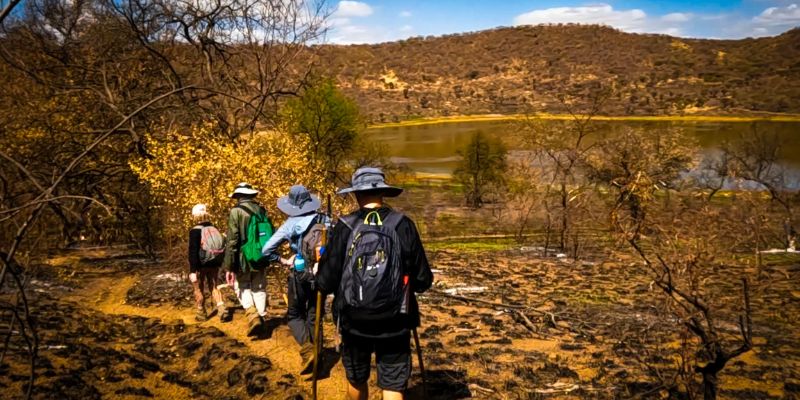
The trail is just over 7km and loops down into the crater and back up to the starting point. The trail has an elevation of 119 meters. As we made our way around the crater, there were points of interest where our guide stopped and shared some knowledge with us. Because of this, the trail took 3 hours to complete.
Along the hike, you can expect to see old run-down structures built when they mined in the area. The vegetation around the crater is primarily a mixture of savanna and grassland ecosystems. Trees include Acacia species (thorny trees), Sclerocarya birrea (Marula tree), and Rhus lancea (Karoo thorn). The area looked burned, and you could smell it in the air.

Next to the main house, which was also a high point of view, there is a Marula Tree. Simon, our guide, explained the tree’s importance to us. In short, the Marula Tree is also known as the Tree of Africa because of its widespread presence, cultural significance, and economic value. See some helpful links below for more historical knowledge of the area.

In my opinion, the best part of the trail would be the high points of view, which made for some good photos. #onsies
The mood I gathered from fellow hikers was positive. Many of us, including me, had been waiting for months to hike the crater. I have been thinking about hiking the crater since 2023. 🙄
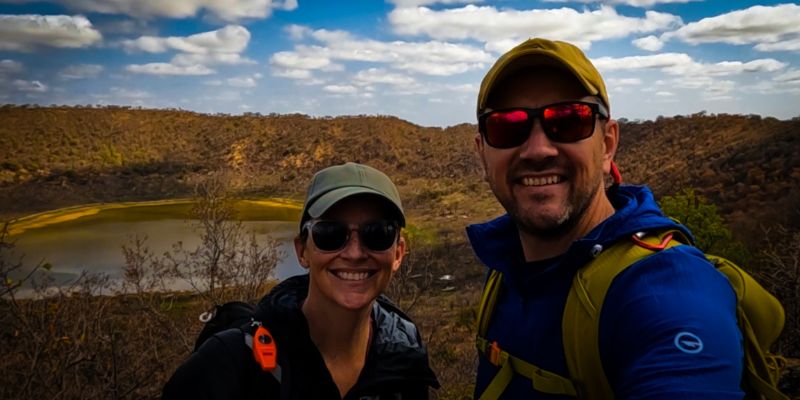
Tanya Pembroke from My Hiking Logbook also joined us on this hike. It was excellent meeting her and chatting about hiking gear, trails, and content creation. Everyone I talked to agreed that the hike was a memorable adventure, offering a combination of natural beauty and historical significance.
It was a morning of good people, nature, and exercise, which is always a win in my book.
My overall experience with the Tswaing Meteorite Crater Hike is okay if you go in a group with a guide. Lower your expectations about the venue. You can’t compare it to venues like Wolwespruit in Pretoria or Torako Trail Park in Johannesburg.

That’s it from me on the Tswaing Meteorite Crater Hike Review. May this inspire you to visit the crater.